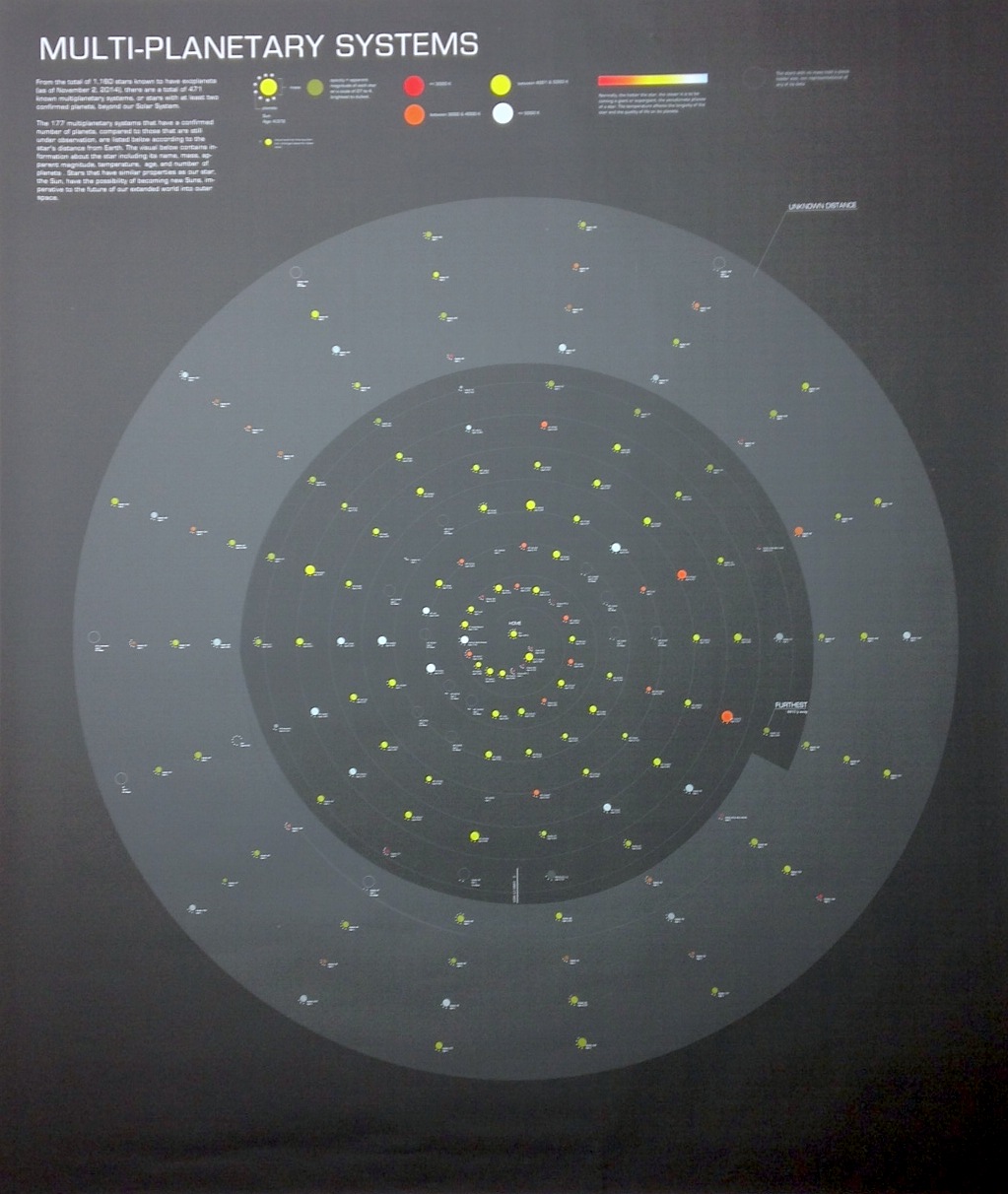
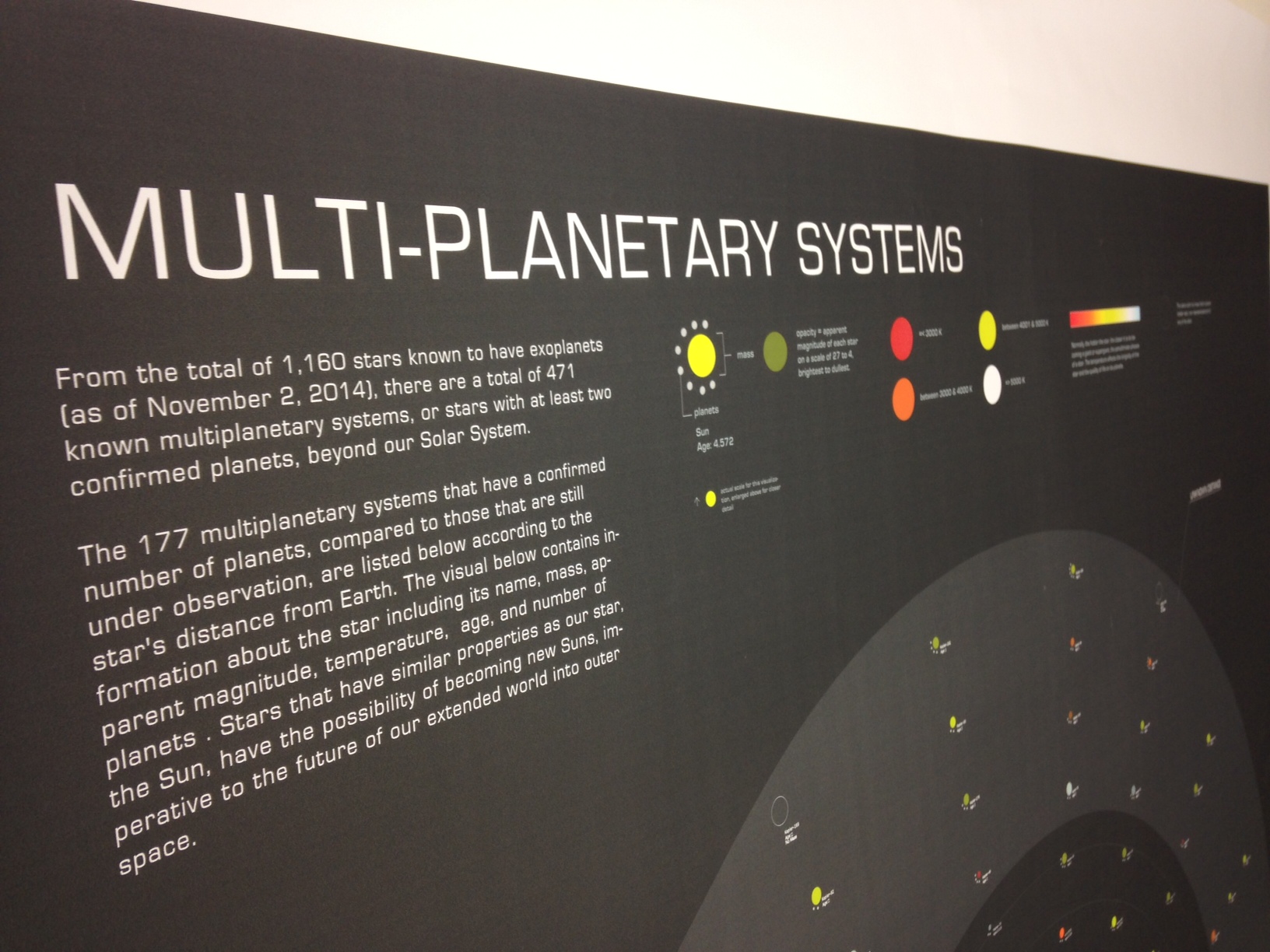
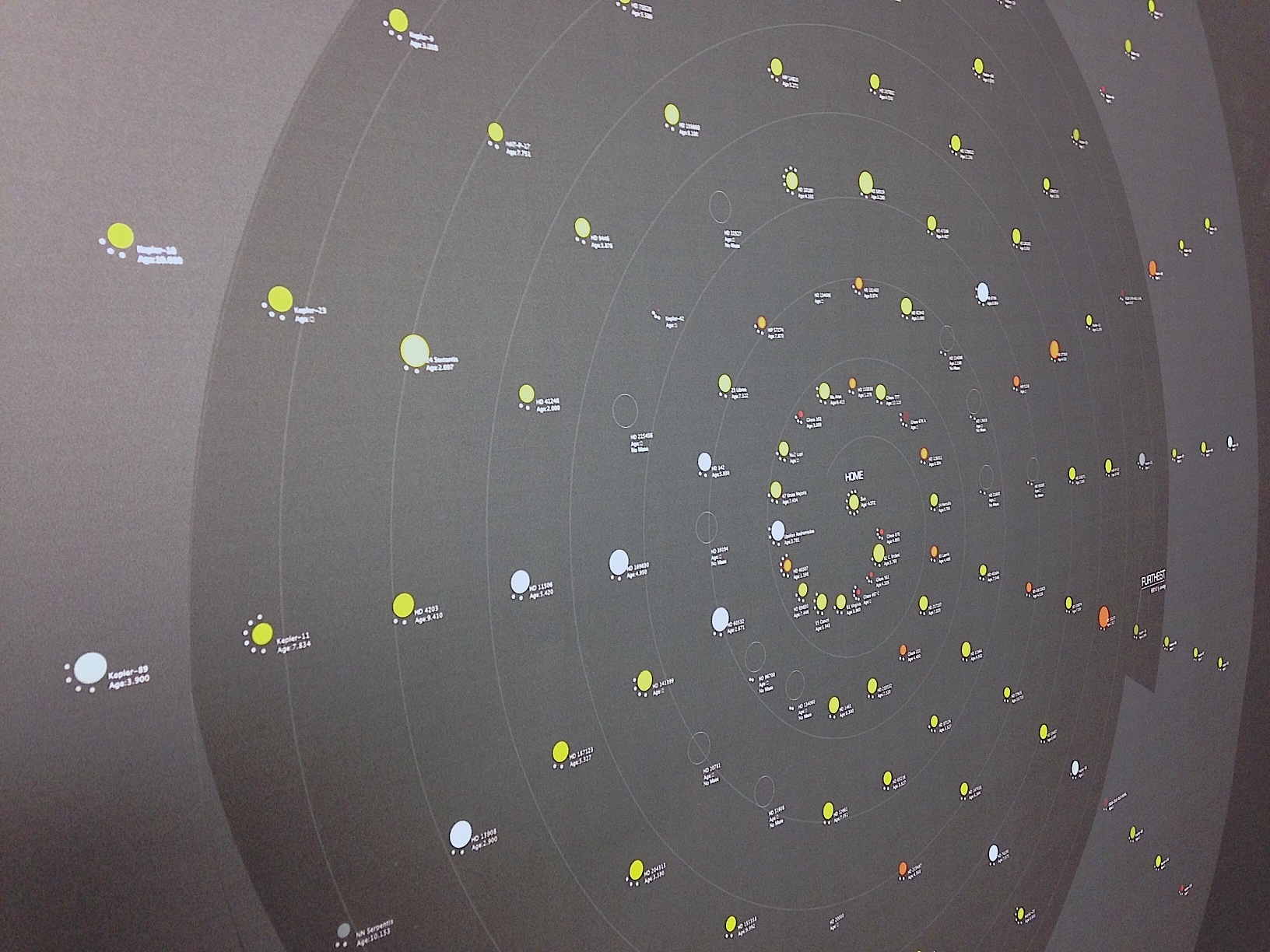
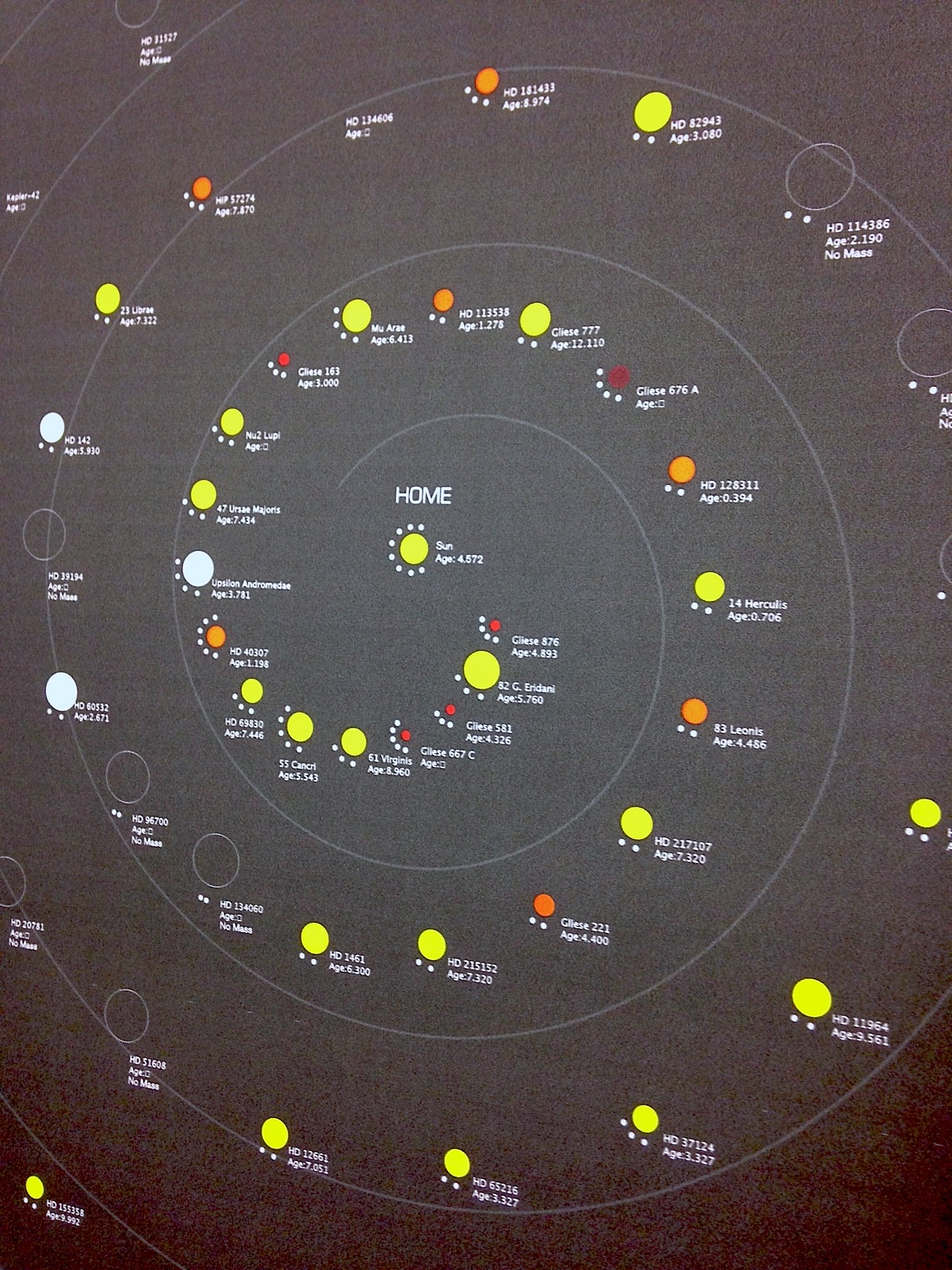
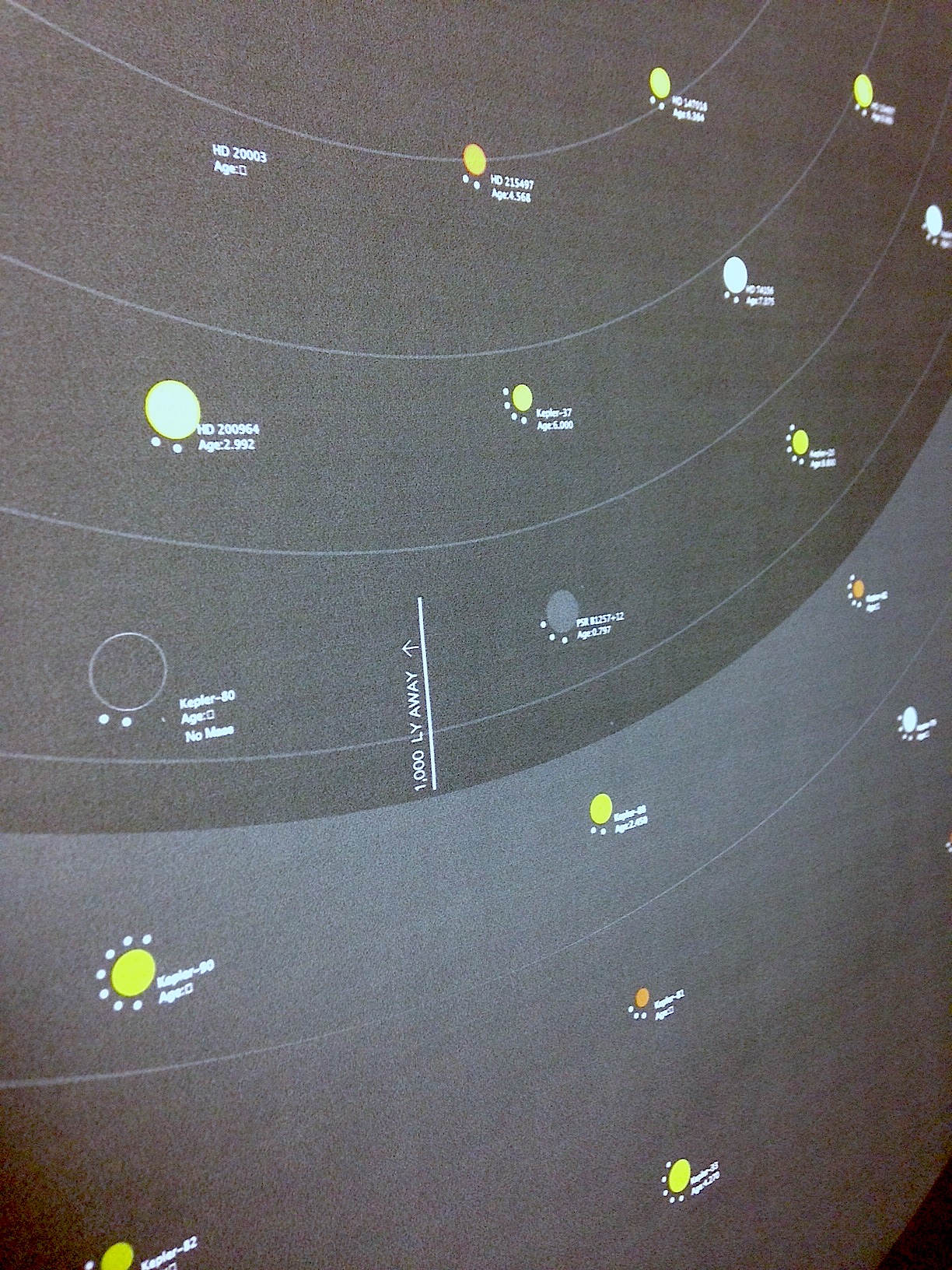
For my final Little Big Data, I created a spiral-esque visualization of the multiplanetary systems spotted by NASA’s spacecrafts, including the famous Kepler, up until 2014. Set in an Archimedean spiral, the stars loop one after the other, the next further in distance than the previous. Many stars have no known distance and are set in a blocked out circle surrounding the spiral. Each star contains an orbit that holds how many planets it contains, along with individual information; its name, age, and mass. Stars with just an outline of the shape visualize stars with unknown mass. The color are in a range depending on their temperature; most saturated are the lower temps, brighter/whiter are the higher temps. The opacity of the stars shows how bright they are to the human eye, or their apparent magnitude. In the center of the spiral is our own Sun which you can then compare and gain an understanding of the other stars, possible locations where other planets like Earth might exist.
My attempts were strongly focused on getting a more logistical spiral to have each star equidistant from one another to show a more apparent distance as the spiral lengthened. The Archimedean spiral is more symmetrical and neat but loses the look of a spiral and adopts a starburst looking shape (not what I’m intending at all). Asides from that and smaller details, I’m somewhat satisfied with the final look. I hope, if/when I go back to it, I’ll point out more features, include information on outstanding stars, systems more similar than others to the Sun or other valuable information worth mentioning.
The combination of Processing and Illustrator was a really strong tool to use for me. I don’t think I’ll ever do a data vis manually ever again. What Processing did was make the process a lot simpler to manage, especially when including tiny information and playing around with all the stars’ positions. It also projected the size of each star, the orbiting planets all equidistant from the star. What worked in Illustrator was the type treatment, smaller navigation, the key, and the blocked out “distance unknown” circle shape.
The easiest thing to do was create the stars by pulling the radius as the mass values in my .csv table. The hardest thing to do was get the spiral working the way I wanted it to (hasn’t really happened yet). It’d be really interesting to also play with the distance more and play with the vast difference in space between the stars (15ly to hundreds of thousands of ly away).
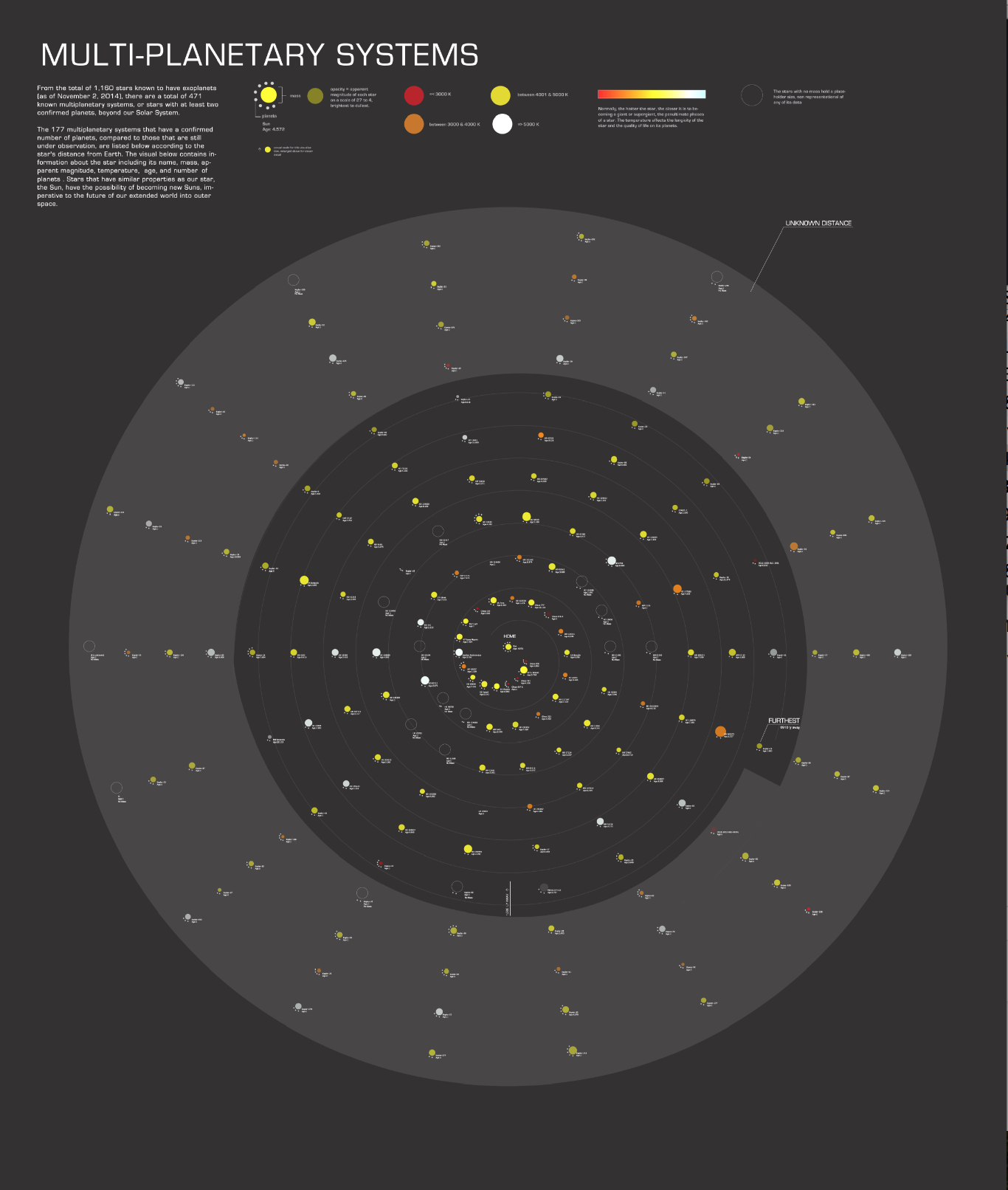
Photo shoot